
Findings you can replay,
not reports you have to trust.
Vexera's agents read your system the way an attacker would and work through complete attack chains. Nothing reaches the report without reproduction evidence and human review. The depth of a serious manual assessment, at the pace of automation.
Platform. Source-to-runtime assessment. Every finding proven, scoped, and governed.
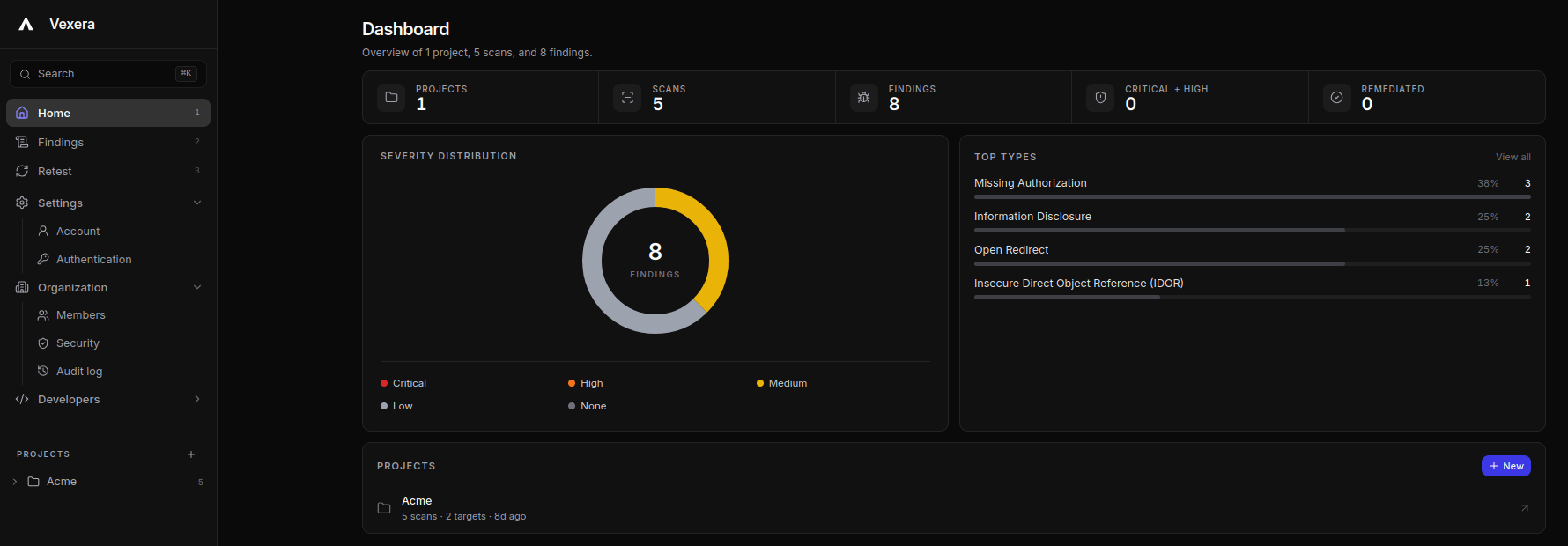
- Source access, a live target, or both
- Scope and rules of engagement
- Credentials agreed for the engagement
- Verified findings, streamed as they land
- Working proof-of-concept exploits
- An engineering-ready report
Verified findings
Findings ship with reproduction evidence, the exact path taken, and validated exploitability. If it can't be reproduced, it doesn't ship.
- Replayable reproduction steps
- Evidence captured at validation
- No unproven output to triage
Source-to-runtime coverage
Whitebox with your source, blackbox from the outside, or both cross-checked against each other. Every surface in scope, streamed live as the engagement runs.
- Web, API, auth & business logic
- Native code & memory safety
- Source & live target, cross-checked
Beyond false positives. Most testing buries you in noise and trivial bugs. Vexera surfaces the vulnerabilities an attacker would actually use, with the exact path that triggers them.
Buried in false positives
Scanners return hundreds of unprioritized alerts. Most are noise your team still has to rule out by hand.
Stops at the surface
Pattern matching flags shallow issues. The exploitable logic flaws and memory bugs underneath need real analysis to reach.
Validation left to you
Findings arrive unproven, so the work of deciding what is actually real never leaves your team.
Replay a revoked invite token against the acceptance endpoint.
Any organization can be joined as a member, exposing cross-tenant data.
Point the test delivery URL at the cloud metadata service through a redirect.
Instance credentials disclosed, opening the internal API surface.
Free a connection object, then reach it from a queued callback.
Controlled write into reclaimed memory, escalating to remote code execution.
Each one arrives reproduced, with a runnable proof of concept and the path to the fix.
Sample dataHow an engagement runs. From the first scoping call to the retest, with the safety boundaries that keep autonomous testing inside the lines.
- 01
Scoping
You tell us the systems in play, the access model, whitebox, blackbox, or both, and what a serious finding looks like for you. We come back with a written scope and a timeline, usually within a day.
- 02
Rules of engagement
We agree what is in scope and what is off limits, the testing window, rate limits, and any data or actions to avoid. Nothing starts until both sides have signed off on the boundary.
- 03
Execution
Agents run the assessment inside the agreed scope, chaining weaknesses the way an attacker would. Verified findings stream to your dashboard as they land, not in a single drop at the end.
- 04
Human review
A senior researcher reviews every candidate finding before it reaches you. Severity, exploitability, and evidence are checked by a person, so a critical means a critical.
- 05
Reporting
You receive an engineering-ready report: each finding with reproduction steps, captured evidence, impact, and a concrete path to the fix. We also state plainly what we reached and what we did not.
- 06
Retest
Once you have shipped fixes, we re-run against the same scope to confirm each finding is closed. Retest status is recorded against the original finding.
Autonomous agents touch your systems, so the boundaries are contractual and enforced, not best effort. These are the guarantees that let you put the engagement in front of production.
Scope lock
The scope you agree is a hard boundary, enforced for the whole engagement. It does not drift wider once testing is underway.
Out of scope stays untouched
Targets outside the agreed scope are never probed, scanned, or exploited, even when an in-scope finding opens a path toward them.
Emergency stop
If we detect instability, a risk of harm, or ambiguity about what is in scope, we pause or stop the assessment rather than push through.
Emergency contact
For production testing we agree an emergency contact path up front, so you can reach a person on our side, and we can reach yours, the moment something looks wrong.
Built by people who would rather find it first.
Vexera comes out of offensive security: vulnerability research and the competition circuit, where finding the bug before anyone else is the entire game. We turned that instinct into a system that runs at the pace of your releases.
We are building the testing we always wished we could buy. Real exploitation over checklists, evidence over adjectives, and a straight account of what we reached and what we did not.
Offensive by background
Built by people who break real systems for a living, not a scanner with a new coat of paint.
Research, not rules
We hunt the bugs no signature list contains: logic flaws, memory corruption, the chains that take actual research to reach.
Senior judgment in the loop
Every finding is reviewed by experienced researchers before it reaches you, so a severity means something.
Outcomes. Offensive testing that keeps pace with how fast you ship, without standing up a team of your own.
- Answers in days
- Scoped in a day, run in days. Findings land while the code is still fresh in the heads of the engineers who wrote it.
- Coverage that keeps up
- Re-run after every release. The annual pentest becomes a standing check on every deploy.
- Senior depth on demand
- Experienced offensive researchers behind every engagement, available the week you need them.
- Scales to your estate
- One service or your full estate, the same method every time, so coverage grows as you do.
Governance. Autonomy you can put in front of an auditor, built from day one for European requirements.
Audit-ready by design.
NIS2 and DORA ask you to prove your controls actually work. An assessment where every finding carries reproduction evidence is that proof.
Your code never trains models.
Contractual zero-training agreements with every model provider Vexera uses. No exceptions, no fine print.
Minimized, ephemeral, purged.
Source is minimized, processed in workspaces that are destroyed when the engagement ends, and not retained. Vexera is a Danish company under EU jurisdiction.
FAQ. The questions a security team asks before the first engagement.
How autonomous is it really, and where are humans in the loop?
The agents do the exploration and exploitation: reading source and live systems, reasoning about attack chains, and building working proof-of-concept exploits at machine speed. Senior offensive researchers set the scope, steer the engagement, and sign off on what ships. You get the throughput of automation with a named human accountable for every claim, not an unattended scanner left running.
What does human review actually mean?
Before any finding reaches your report, an experienced researcher reproduces it and confirms that the impact is real and the severity is right. Anything that cannot be reproduced does not ship. Review is validation against concrete evidence, not a second opinion on a scanner's guess, so a severity from us means something.
What happens to our source code, exactly?
Source is minimized to what the engagement needs and processed in an isolated workspace that is destroyed when the engagement ends; we do not retain it afterwards. Every model provider we use is under a contractual zero-training agreement, so your code never becomes training data. Vexera is a Danish company, and your code and findings stay under EU jurisdiction.
Is it safe to run against production?
Scope is a hard boundary and out-of-scope targets are not touched. If we detect instability or risk of harm, the engagement pauses, and you hold an emergency stop and an agreed emergency contact throughout. Where a representative staging environment exists we prefer it, but production testing is supported under the rules of engagement we agree first.
Who authorizes testing, and how is liability handled?
We test only systems you own or are explicitly authorized in writing to test, and testing stays inside the agreed scope and rules of engagement. Authorization, scope, and the emergency contact are fixed before anything runs, under an MSA and statement of work governed by Danish law. If scope is ambiguous, we stop and ask rather than assume.
How does pricing work?
Pricing is fixed-scope and per engagement, published on our pricing page: an Assessment is €3,900, a Deep engagement is anchored at €8,900 and confirmed at scoping, and continuous Enterprise coverage is quoted per portfolio. There are no seat licenses and no per-scan metering to reason about. You know the price of an engagement before it starts.
What do we actually receive?
Verified findings stream to you as they are proven, each with reproduction steps, the exact path taken, and a working proof-of-concept, so your engineers can start fixing before the engagement closes. At the end you get an engineering-ready report, and retest of the fixes is part of the engagement. If something cannot be reproduced, it is not in the report.
How is this different from a scanner or a bug bounty?
A scanner matches signatures and hands you a queue of unverified alerts to triage; we hunt the logic flaws, chained exploits, and memory-safety bugs no signature list contains, and we prove each one. Unlike a bug bounty, an engagement runs to a defined scope and timeline with senior researchers you can plan around, not an open-ended crowd with variable coverage. You get proven exploitability and a report an auditor accepts, not a pile of maybes.
Start with one system.
The fastest way to judge Vexera is on your own code. Tell us about the system you want tested and we will come back with a scope and a timeline.